Spring in Dallas doesn’t arrive gradually, it hits. One week the lawn is dormant, and the next it’s pushing new growth faster than most homeowners expect. That shift raises a straightforward question: how often to mow your lawn in spring without scalping it or letting it get ahead of you? The answer depends less on a fixed schedule and more on how your grass is actually growing, which changes week to week across North Texas.
At Greenform Landscapes, we manage mowing timing across established Dallas properties where turf health and appearance both matter. The approach we rely on, and the one this guide is built around, is the one-third rule, a principle that protects root development and keeps turf dense through the unpredictable swings of a North Texas spring. Below, we’ll walk through when to start, how frequently to mow, and how to adjust as temperatures climb from March into May.
Know what drives spring mowing frequency in Dallas
Understanding how often to mow your lawn in spring starts with recognizing that Dallas turf doesn’t behave like grass in other parts of the country. North Texas lawns are dominated by warm-season grasses, primarily Bermuda, St. Augustine, and Zoysia, each with different growth rates and spring emergence timelines. When soil temperatures climb above 65°F, these grasses shift out of dormancy and begin pushing growth rapidly, which can compress your mowing schedule from every two weeks down to every five or six days within a single season.

Grass type determines your baseline schedule
Bermuda grass can outpace your expectations once temperatures hold in the 70s. Bermuda typically requires mowing every five to seven days during peak spring growth, while Zoysia moves more slowly and may allow a seven-to-ten-day window. St. Augustine falls somewhere in between, depending on how much sun and irrigation your lawn receives. Knowing your turf type gives you a reliable starting point before you even look at the calendar.
Dallas clay soil and its effect on timing
North Texas clay soils retain moisture longer than sandy soils, which means your lawn can stay wet and soft after spring rains. Mowing on saturated clay-based soil compacts the ground and can tear grass roots rather than cut cleanly. On properties in areas like Preston Hollow where mature tree canopy also slows soil drying, you may need to extend your schedule by a day or two after significant rainfall rather than pushing through on a fixed rotation.
Soil moisture matters as much as grass height when deciding whether today is the right day to mow.
Weather variability adds another layer
North Texas springs are not linear. A warm stretch in late February can trigger early growth, followed by a cold snap in March that slows things down again. Tracking your actual grass height, rather than relying solely on a calendar, gives you the flexibility to respond to these shifts without under-cutting or neglecting your lawn during a fast-growth window.
Step 1. Start the season at the right time
The most common mistake Dallas homeowners make is mowing too early. Starting before your turf has fully broken dormancy stresses the grass and can set back growth at a critical point in the season. Your first mow should be guided by soil temperature, not the calendar date, and by watching the actual condition of your lawn rather than assuming a fixed start week.
Watch for these signs before the first cut
Your lawn will tell you when it’s ready. Look for consistent green color across at least 50% of the turf surface and new vertical leaf growth rather than lateral spread alone. For Bermuda lawns, this typically happens when soil temperatures hold above 65°F for several consecutive days, which in Dallas usually falls between mid-March and early April depending on the year.
Your first mow of the season sets the tone for how your turf performs through May.
A practical way to confirm timing is to check soil temperature using a probe thermometer at a 2-inch depth. If you prefer a reference point, local university extension programs track Dallas-area soil temperatures through late winter. Once the reading holds consistently, make your first cut at the upper end of your grass type’s recommended height range rather than cutting aggressively from the start.
Step 2. Set height using the one-third rule
The one-third rule is the most practical framework for deciding how often to mow your lawn in spring across North Texas turf. The principle is straightforward: never remove more than one-third of the blade height in a single cutting. Cutting deeper than that forces the grass to redirect energy from root development to blade recovery, which weakens density and slows overall spring green-up.

Apply the rule by grass type
Your target maintenance height depends on the turf you’re managing. The table below shows the recommended maintained heights and the maximum blade length that should trigger a mow for the three most common Dallas grass types.
| Grass Type | Maintained Height | Mow Before It Reaches |
|---|---|---|
| Bermuda | 1.5 – 2 in | 2.25 – 3 in |
| St. Augustine | 3 – 3.5 in | 4.5 – 5.25 in |
| Zoysia | 1.5 – 2.5 in | 2.25 – 3.75 in |
Letting grass exceed these thresholds before cutting forces a more aggressive trim, which stresses root systems and thins turf over time.
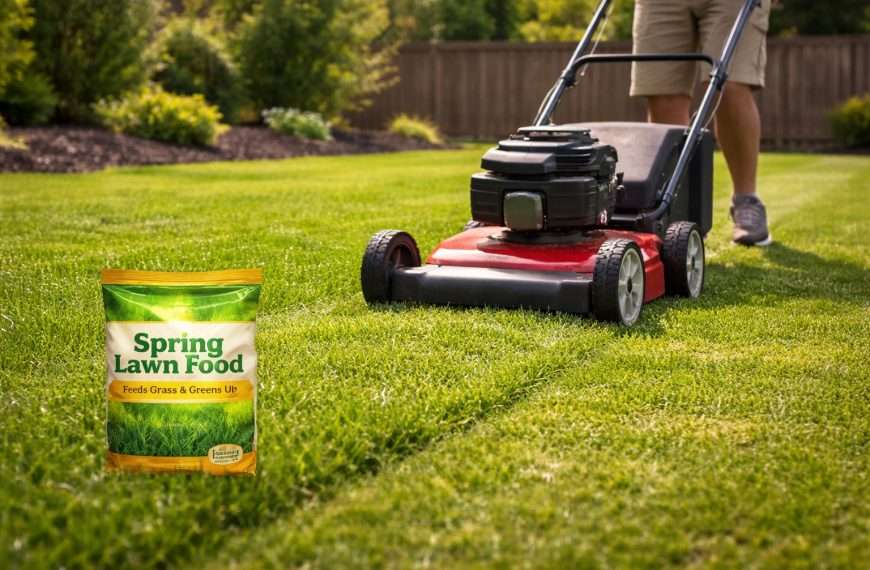
When spring growth accelerates through April, your Bermuda lawn may reach its trigger threshold every five to six days. Rather than waiting for a fixed schedule, check blade height mid-week and mow as needed to stay within the one-third limit.
Step 3. Choose a spring mowing schedule that fits your turf
A fixed mowing day works fine in summer, but spring growth in Dallas doesn’t follow a calendar. Knowing how often to mow lawn in spring means building a schedule around your specific turf type and adjusting it week by week as conditions shift from March through April.
Build a flexible schedule by growth phase
Rather than committing to a single mowing day, check blade height twice a week against your one-third trigger and mow when your grass hits the threshold. The schedule below gives you a practical starting point by grass type across both phases of a North Texas spring.
| Grass Type | Early Spring (Mar) | Active Growth (Apr) |
|---|---|---|
| Bermuda | Every 7–10 days | Every 5–7 days |
| St. Augustine | Every 10–14 days | Every 7–10 days |
| Zoysia | Every 10–14 days | Every 7–10 days |
Your schedule should follow what the grass is doing, not what the calendar says.
When a rainy stretch accelerates growth faster than expected, mow ahead of your usual window rather than waiting and removing too much at once. Staying responsive through April protects turf density during the most demanding growth window of the year.
Step 4. Fix common spring mowing problems fast
Even with a solid schedule, a few recurring issues can disrupt your spring results before you catch them. Knowing how often to mow your lawn in spring is only part of the equation; recognizing when something has gone wrong and correcting it quickly keeps your turf on track through the rest of the season.
Scalping after a missed cut
When growth outpaces your schedule, the natural response is to cut straight down to your target height in one pass. Resist that instinct. Cutting more than one-third of the blade at once stresses root systems and exposes the soil crown to direct sun. Drop your cutting height gradually over two or three sessions spaced a few days apart until you return to your target range.
Recovering from a missed cut over multiple sessions does less damage than one aggressive pass.
Clumping clippings on the surface
Thick clippings left on the surface block sunlight and trap moisture against the soil, encouraging fungal issues during warm, humid spring stretches. Clumping almost always signals that too much time passed between cuts. If your mower discharges clumps, try one of these corrections:
- Slow your mowing pace
- Change your cutting direction
- Raise your blade one notch and mow again in a few days
Keep your spring schedule on track
Spring mowing in Dallas isn’t complicated, but it does require consistent attention through March and April when growth moves faster than most homeowners anticipate. The answer to how often to mow your lawn in spring isn’t a fixed number; it’s a habit of checking blade height twice a week and cutting when your grass tells you it’s ready, not when the calendar says so.
Follow the one-third rule, match your frequency to your turf type, and correct any missed cuts over multiple sessions rather than one aggressive pass. These habits compound over the season, producing denser, more resilient turf that holds up through the heat of a North Texas summer.
Understanding mowing frequency, proper height, and seasonal timing can make a big difference in lawn health. If you’d rather leave the maintenance to professionals, Greenform Landscapes provides lawn care services throughout Dallas and surrounding neighborhoods.
Our team handles mowing, seasonal treatments, and complete lawn maintenance so your yard stays healthy all year.
Contact us today to schedule a lawn care consultation.